
Supplies were limited, so the crew had to learn how to do everything themselves. This included growing their own food and repairing equipment inside the base. Life inside the habitat wasn’t easy. The base was only about 1,700 square feet (158 square meters). That’s about the size of one-third of a basketball court – not much space for four people to live in together for over a year.
For 378 days, four members of a NASA crew lived in a small, 3D-printed building that was designed to feel exactly like a base on Mars. The project was meant to test what it would be like for humans to live alone on a distant planet.
One of the biggest challenges was communicating with Earth. To make the mission feel real, NASA added a time delay to all messages. If the crew sent a message to “Earth”, it could take 22 minutes to arrive. Getting a reply back could take another 22 minutes.
The mission finally came to an end on October 31, when NASA astronaut Jack Hathaway knocked on the base door, saying “trick or treat.” After more than a year of living in their Martian environment, the crew finally stepped outside, happy to be home.
The crew was part of a NASA program called CHAPEA, which stands for “Crew Health and Performance Exploration Analog”. The “analog” part means that NASA tries to create an artificial environment that is as close to the real thing as possible. Because a real trip to Mars is so difficult, an analog mission is one of the best ways to learn how astronauts might handle the challenges of living on Mars.
Life inside the habitat wasn’t easy. The base was only about 1,700 square feet (158 square meters). That’s about the size of one-third of a basketball court – not much space for four people to live in together for over a year. Above, two of the bedrooms. (Source: Bill Stafford [Public Domain], NASA.)
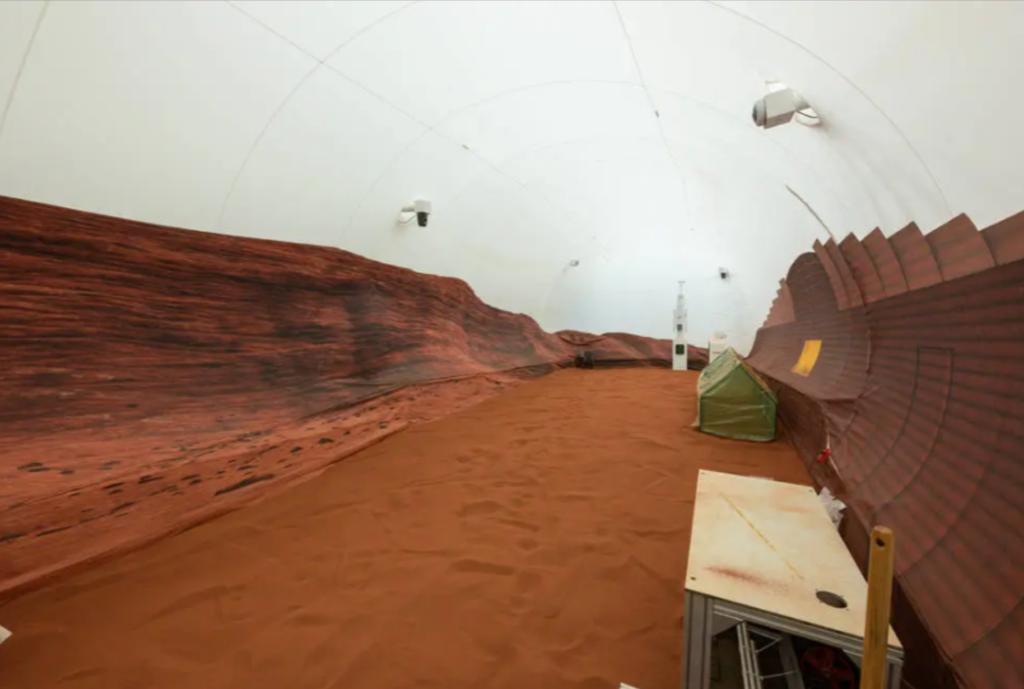
The mission took place at the Johnson Space Center in Houston, inside a habitat called Mars Dune Alpha. That’s a small base set up like a real Mars base might be. The habitat even has an outdoor area that looks like the Martian landscape, complete with red sand.
The crew members were carefully chosen for their skills. Ross Elder, a test pilot for the US Air Force,
led the mission. Ellen Ellis, a US Space Force officer, served as the medical expert. James Spicer acted
as the flight engineer and handled communications, while Matthew Montgomery used his skills in
robotics to assist with many different technical tasks.
For one two-week period, the crew even experienced a “blackout”, with no communication at all. This
is something real astronauts would face if the sun blocked radio signals between Earth and Mars.
The crew – three men and one woman – entered the base on October 19, 2025. For more than a year,
they lived and worked together in this Martian environment, never even seeing the sun.
Though the crew members were all volunteers, NASA didn’t pick the team by chance. Instead, they
spent over a year testing the crew’s personalities, making sure they could handle stress and work well
together. The 1,700-square-foot CHAPEA habitat contains individual living quarters for four
volunteer crew members.
They also practiced “EVAs” – leaving the base through an airlock to explore the surface of “Mars”
while wearing special suits. They also used drones and robotic vehicles to collect information from the
area outside.
NASA’s Analog Missions
Vanessa Wyche, who leads the Johnson Space Center, says the efforts of the crew will help NASA
“understand what it will take to send humans to Mars.”